Sigur Johanson
The SwarmSigur Johanson is a marine biologist whose scientific curiosity and attachment to older ideals place him at odds with a crisis increasingly governed by ambition, secrecy, and military force. He studies anomalous marine life as evidence of relationships humans do not yet understand, and ultimately opposes a plan to attack the Yrr with a weapon whose consequences cannot be predicted. His arc turns on a difficult distinction: recognizing the threat the Yrr pose does not make an indiscriminate human counterattack wise or safe.
Identity and outlook
Johanson lives in Trondheim, in an old-fashioned ground-floor apartment in Møllenberg. Its ochre-coloured house, pitched roof, white steps, and lintel belong to a streetscape that suits his affection for the past. He is a thoroughly modern scientist, but has little admiration for the present as an age of practical compromises. His imagination draws instead on Jules Verne: on chivalry, the pursuit of what seems impossible, and the promise of technology. That combination makes him neither a simple traditionalist nor an uncritical futurist. He welcomes discovery and technical invention, but is wary of a culture that values them chiefly for convenience, profit, or control.
His habits give this outlook a domestic scale. Johanson keeps supplies of wine and grooming products, including Kiton eau-de-toilette, and notices when one of life’s small luxuries seems to be missing. In the office, Tina Lund teases him about being late and speculates about the previous night. Their exchange conveys familiarity and ease between colleagues, a lighter counterpoint to the scientific and political pressures that increasingly surround him.
Johanson’s affection for marine organisms is especially apparent in his response to polychaetes. He identifies the worms as members of the Annelida phylum: segmented animals that may seem simple but have persisted, practically unchanged in the fossil record, since the Middle Cambrian, more than 500 million years ago. They aerate sediment and feed fish and crabs; while many people find them repellent, Johanson sees them as survivors of a lost world and finds them beautiful. His attention is not limited to organisms that resemble or serve humans. The worms’ deep history is itself a reason to take them seriously.
Worms, research, and ambition
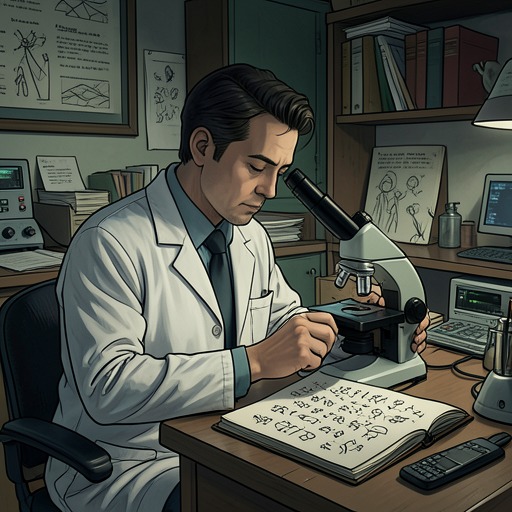
When Johanson examines the anomalous worms, he objects that the specimen under discussion is really two separate worms. Reports describe polychaetes with similarities to Hesiocaeca methanicola, but their jaws are unusually large and their mandibles are powerful, apparently adapted for boring or burrowing. These anatomical details shift the worms from a taxonomic curiosity toward a possible agent in the disturbance of methane hydrates.
The research matters in a period of climatic fluctuation because oceanic hydrate reserves are volatile. Heiko Sahling acknowledges that concern and explains why the worms are attracting attention. The issue is not simply what the animals are, but what their activity might mean for unstable material beneath the seabed. Johanson’s work therefore connects close observation of an organism to much larger questions about the ocean and climate.
That caution is tested by a competing technological ambition. The subsea unit is a career-making prototype for Finn Skaugen, who has treated it as his own project and wanted to be the first to launch a successful prototype. In pursuing that goal, Skaugen has chosen to ignore the worms. Johanson feels embarrassed for him, but Skaugen apologizes for drawing him into the situation and reminds him that he is part of the team. Their exchange reveals the conflict between a project’s immediate professional stakes and evidence that may demand a change of course. Johanson’s scientific role is not detached from institutional ambition: he must work within it while insisting that inconvenient biological findings cannot simply be set aside.
The sea as a limit on knowledge
The novel’s descriptions of the ocean give physical form to the limits Johanson encounters as a scientist. Beyond the continental shelf, which may extend for hundreds of kilometres before dropping toward the ocean floor, lies a realm described as more mysterious to science than outer space. At sea, the horizon can dissolve into rain, dark waves, and cloud; with no visual markers, the boundary between sky and water becomes difficult to fix. These conditions do more than create an imposing backdrop. They make clear how little human observation can secure in an environment that exceeds familiar ways of orienting oneself.
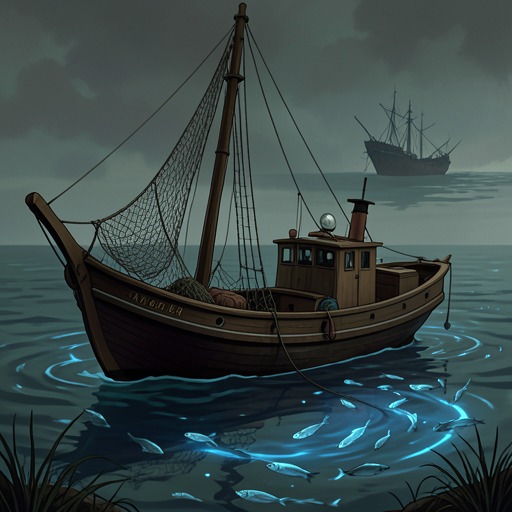
Johanson’s investigations unfold against that uncertainty. During the disturbance associated with the slide, the Thorvaldson is at sea as the continental shelf and slope descend. The movement displaces water across a vast area, but near the slide the resulting wave is so flat, and its height above the water so slight, that it goes unnoticed amid the storm. The scale of the process and the difficulty of detecting it belong together: consequences can begin in a form that gives people little warning.
The destruction reaches Johanson’s home in Trondheim. The water sweeps through the harbour and old town, breaks the Nid’s banks, and floods Bakklandet and Møllenberg. In Kirkegata, the house he valued is almost entirely destroyed: its facade gives way, its roof collapses onto the walls, and the debris is carried off by the torrent. The loss makes the upheaval personal without changing its scale. A cherished human dwelling is no more secure against the water than the surrounding streets.
From ecological evidence to political crisis
As reports of marine attacks accumulate, a public position emerges that refuses to endorse retaliation before the cause is known. The speaker insists on withholding speculation, warns against vigilante responses from fishermen, industry, shipping, whale-watchers, and activists, and argues that violence against the animals would be foolish while their behaviour remains unexplained. Johanson’s later interpretation develops this demand for explanation into a more radical account of the crisis.
At the emergency committee, secrecy and military action increasingly frame the discussion. Judith Li explains why the committee is isolated at Chateau Whistler, where helicopters and a closed hotel attract attention but the public is told only that the gathering is an exercise. She presents silence as necessary to prevent panic and describes the situation as a war in which truth is the first casualty. The committee’s methods include city quarantines, troops with flamethrowers around key coastal cities, and plans for an antitoxin. Li also announces the use of SURTASS LFA against whales, with the intention of deafening them through destructive sound. These measures turn an ecological emergency into a contest over who may define the threat and what violence may be justified in response.
Johanson does not immediately disclose his own theory. He nearly raises it in a private conversation with Karen Weaver after the presentation, but speaks only in allusions. Later, when he addresses the wider problem, he rejects explanations based on a sequence of unrelated natural disasters, a terrorist organisation, a rogue state, or evolution alone. He understands the attacks as a war between two worlds long treated as one because they share the same planet: intelligent life has been present in the oceans all along. His account changes the scale of the crisis. The sea is not merely a setting for human events, and the beings there are not just instruments of disorder.
Johanson also argues that the Yrr may be acting because humans are threatening their habitat. In that account, the harm humans have done in a short span of planetary history gives the other species reason to respond rapidly. He points to the Gulf Stream’s stoppage as part of that response. The claim is grave, but it does not lead him to endorse an armed answer. Instead, his interpretation makes human vulnerability inseparable from human responsibility.
Contact, collective life, and conflict
Johanson’s understanding of Yrr biology helps explain why he resists conventional ideas of weaponry. He considers that their technology may be biological rather than mechanical: genes and deliberately shaped life-forms could perform the work humans assign to machines. Such a civilization would be bound to nature in a way human societies are not. For him, that possibility is not just a technical hypothesis; it challenges the assumption that intelligence must appear in a form familiar to human observers.
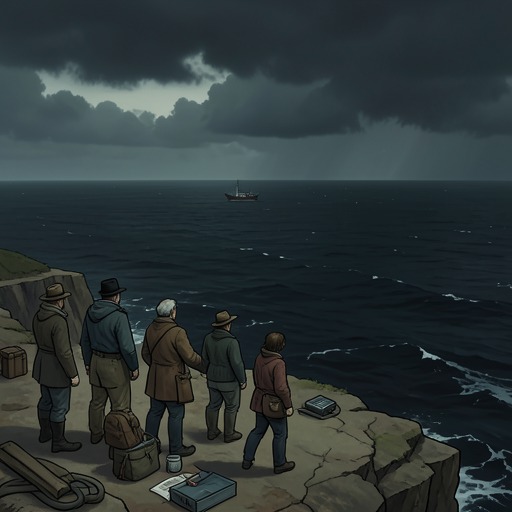
He also influences where the attempt at contact takes place. With Gerhard Bohrmann and Karen Weaver supporting him, Johanson helps ensure that the expedition enters the Greenland Sea rather than proceeding thousands of kilometres farther south toward hydrothermal vents on the Mid-Atlantic Ridge. Mick Rubin, Leon Anawak, and others favour the more southerly location, partly because of the crabs there and the habitat the vents provide. Johanson’s intervention reflects a dispute over how to search for the Yrr, not simply a difference about the best-looking site. The team must decide what evidence of intelligent life might mean and where that evidence can be approached.
Inside the tank, white carapaces and spindly crab legs move across an artificial seabed. Some crabs circle or stop, seemingly disoriented; underwater cameras transmit close views to monitors. The controlled enclosure lets the researchers observe them, but it also emphasizes the gap between seeing behaviour and understanding it. Johanson later reaches a more consequential conclusion about the luminous jelly and cloud: they are not separate entities but a network of single-cell organisms that can disperse and reassemble. The apparent individual body is a temporary form of a larger collective.
The laboratory work makes that discovery materially specific. Johanson and Sue Oliviera isolate cells from the jelly, subjecting them to freezing and heat, breaking down proteins with proteinase, and separating the resulting solution through phenol treatment and centrifugation. The work leaves them with a small quantity of clear fluid to send for sequencing. While waiting for the results, Oliviera suggests a cigarette break; Johanson instead returns from his cabin with two glasses and a bottle of Bordeaux. His customary attention to wine persists even at the edge of a potentially major discovery, a small human routine inside an investigation that is steadily unsettling the boundaries between organism, colony, and intelligence.
Memory, resistance, and ending
Johanson’s capacity to act is complicated by a disorienting episode. At a later gathering, he arrives late and appears unwell, repeatedly looking around as if to reassure himself that the people present are real and that he is not hallucinating. Li knows something has happened during a night-time episode and is uncertain how much he remembers or whether he is telling her the truth. Johanson gives her the account he can reconstruct, including the parts that make no sense to him and the doubts raised by her questioning. The strain is therefore not only a gap in memory but also the loss of confidence in his own account of events, while another person’s knowledge of the episode becomes a source of pressure.
That experience does not remove his judgment about the proposed weapons. When he objects to the plan, he argues that biological weapons require only one recipe because reproduction can do the rest. Later, he confronts Li directly. He distrusts her assurance that the weapons will not be used and warns that the target is not a single creature that can be eliminated cleanly, but millions or billions of single-cell organisms whose ecological role is still unknown. Killing them could have consequences for the oceans and for humanity, while failing to restore the Gulf Stream or resolve the worm problem. His objection rests on both uncertainty and interdependence: the proposed attack may not achieve its stated aims, and its costs cannot be calculated in advance.
The conflict becomes personal when Li acknowledges that Rubin should never have hit him, and Johanson rejects the assurances surrounding the weapons program. Alone later, he is confronted by Li with a gun and two slim cylinders beside her on the jetty. He says that he has sabotaged the boat. The action makes his opposition concrete: rather than limiting himself to a scientific warning, he tries to prevent the vessel carrying radioactive pheromone from proceeding with the attack. He is left critically wounded, but still acts in an effort to stop the plan. A torpedo he launches travels less than three metres before striking a steel wall and exploding. His intervention fails to produce the intended counterattack; its significance lies instead in his refusal to let fear and certainty substitute for knowledge.
Johanson’s ending brings his central tension to its sharpest point. He recognizes the Yrr as a danger and interprets their actions as a response to human damage, yet refuses to treat their destruction as an acceptable shortcut to safety. The descent into the ocean is portrayed as entry into an inner space where familiar perceptions fall away and even the direction of movement becomes difficult to judge. That image suits the limits his work has exposed throughout: the deep sea is not an empty frontier awaiting human command, but a living world whose complexity outruns the weapons and explanations brought against it.